
2025-12-10
BESS most frequently appears in renewable energy planning because of its strong efficiency and rapid system response. BESS provides fast frequency regulation and efficient daily cycling, while hydrogen storage provides a very different value proposition. Hydrogen systems show exceptional long duration and seasonal storage capability. In comparing these technologies fairly, it helps to juxtapose strengths with the help of such insights from credible research as the International Energy Agency report titled Batteries and Secure Energy Transitions.
A battery energy storage system has high round trip efficiency with near-instant dispatch. In its global analysis, the IEA highlights how modern lithium-based systems stabilize renewable-heavy grids by performing rapid corrective actions. This responsiveness positions BESS as a strong asset for frequency control and short-duration balancing.
Hydrogen storage involves several energy conversion steps. Electricity becomes hydrogen through electrolysis which is later stored and converted back to electricity when needed. Sandia National Laboratories explains the technical implications of this pathway in its hydrogen storage chapter.
Although these steps reduce efficiency, they enable extremely large storage capacities, particularly when geological formations are available.
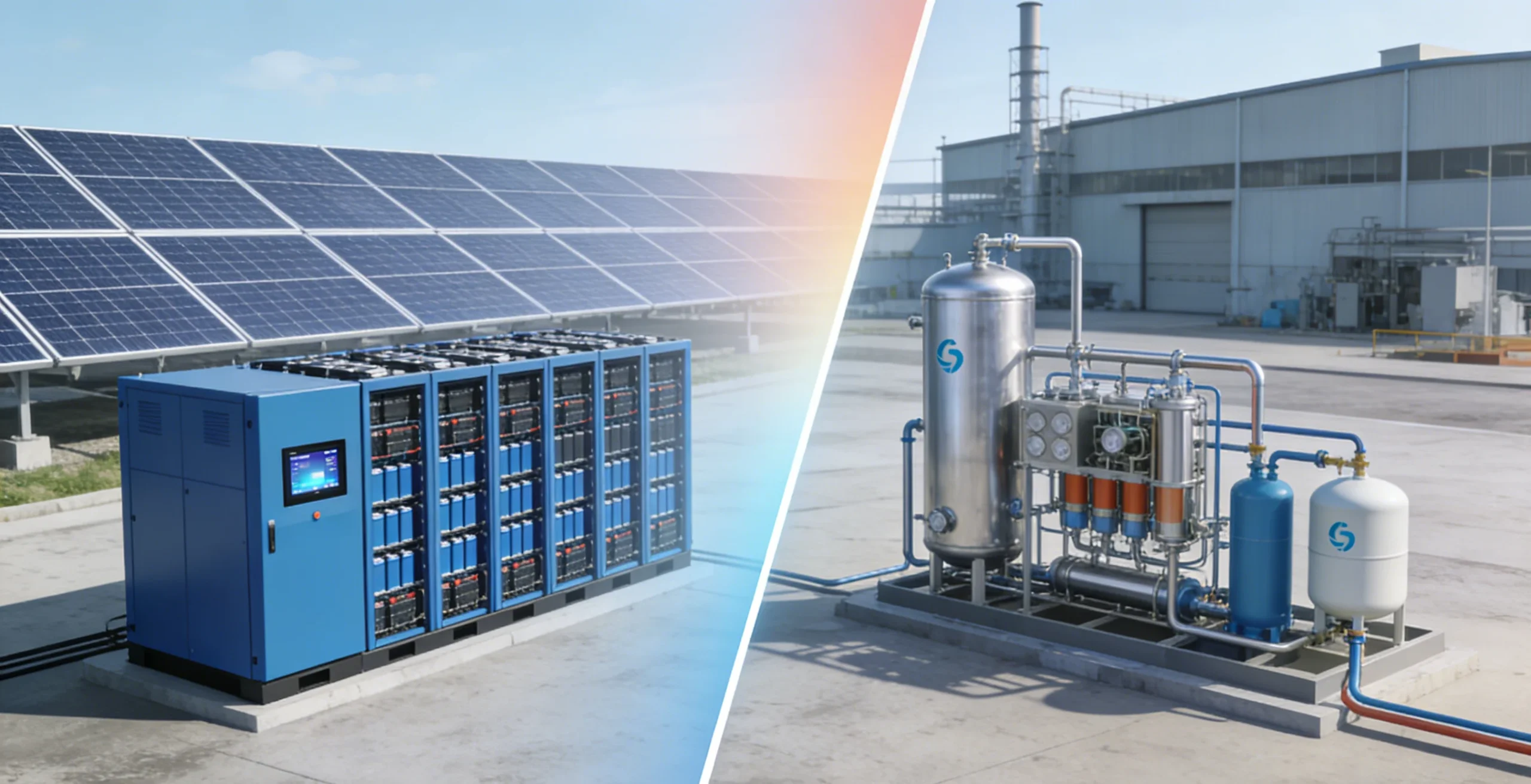
Because BESS is modular and highly responsive, it fits applications where energy is needed for minutes up to several hours. Operators very often deploy it near load centers or renewable plants to manage rapid fluctuations. Hydrogen storage, on the other hand, is effective when long-duration coverage is a priority. The National Renewable Energy Laboratory compares the two systems across varying durations and infrastructure conditions in its detailed study.
NREL finds that hydrogen becomes more favorable when storage durations extend far beyond the practical range of batteries.
BESS typically has a higher capital cost per unit of stored energy but balances this with formidable operational efficiency and predictable degradation. Applications feature batteries where frequent cycling is required, and the associated efficiency and responsiveness together yield quantifiable value.
It requires more infrastructure for the process of storing hydrogen: a larger number of electrolyzers, compression systems, and sometimes even special geological storage. Although the conversion losses reduce efficiency, the capability of storing energy for days or even months without significant loss is a major strategic advantage. Where renewables vary seasonally, hydrogen storage can provide resilience levels that batteries alone could not cost-effectively match.
South Australia implemented grid scale battery systems to resolve frequency instability. The installation provided very fast response for renewable variability and showed significant reductions in reliance on traditional peaking units. This case represents a situation in which BESS excels for systems that require fast regulation with daily cycling.
One renewable initiative based in Utah utilized underground hydrogen storage to secure multi-day and seasonal backup. Hydrogen allowed for the capture of extra renewable power at high generation periods and storage for extended use. This project shows how hydrogen systems fit long duration and large scale requirements that exceed typical BESS capabilities.
| Attribute | BESS Performance | Hydrogen Storage Performance |
| Response speed | Near instantaneous | Slower due to conversion |
| Duration | Minutes to hours | Days to seasons |
| Round trip efficiency | High | Lower due to multiple steps |
| Scale potential | Modular but limited | Very large with geological storage |
| Ideal use | Fast reserves and daily balancing | Seasonal storage and long duration resilience |
The choice between BESS and hydrogen storage is thus related to the goal. In cases requiring fast reserves of high efficiency, or when operators need frequent cycling, a battery energy storage system works best. This perspective reinforces that from comparative studies at NREL, which show strong BESS advantages in the case of short-duration scenarios.
Hydrogen becomes the more strategic option when planners need to prepare for extended low renewable periods, or when large-scale storage aligns with industrial hydrogen integration. Sandia research underlines the factors affecting the geological conditions and infrastructure readiness that determine hydrogen deployment feasibility.
The differences between BESS and hydrogen storage are important to understand for resiliency and economical energy systems. BESS excels in efficiency and immediate grid support while hydrogen storage enables very long duration coverage and large scale resilience. IF you are interested in the energy storage strategy you can check our latest insights.

How to Optimize Thermal Management in Solar Container
The Future of High-Density Storage: 5MWh+ in a Single 20ft Container

Second-Life EV Batteries in Solar Containers: Technical Challenges and Solutions

Corrosion Resistance 101: Why C5-M Coating is Essential for Offshore Solar Platforms

The Role of Smart Monitoring Systems in Extending Solar Container Lifespan