
2025-12-22
Shipping container house, it seems, can be easily mistakenly equated with affordable housing. It’s steel, it’s containers, it’s easy. It all seems so simple in principle. However, the truth of the matter is that the price of a shipping container home involves far more considerations than the initial price tag of the containers. If you are considering whether or not the housing option of the shipping container home actually provides financial benefits, it can be helpful to take a closer look at what it entails.
A shipping container home may be cheaper than a regular home, and it doesn't necessarily mean it is inexpensive. This varies based on levels of complexity in its design, what determines its cost according to authority regulations, what’s its on- or off-site construction, and so forth.
Knowing such variables gives much more insight than attempting to isolate a single price.

When we generally inquire about the cost of a shipping container home, we have three different possibilities in mind.
For each of these, there is a considerably different cost structure involved. The packaging is just one part of it, and not necessarily the most expensive one.
In terms of cost, container housing is part of the larger market of factory built or modular housing. Factory based housing construction is noted in the United States Department of Housing and Urban Development report on factory built housing and affordability as capable of lowering waste, reducing construction time, and decreasing the intensity of labor as needed for fully constructed housing on site when the conditions are favorable for full factory based production.
Although the HUD study is not specifically oriented to container homes, their findings can certainly be applied. Container houses can be dominated by off site fabrication, in which such things as insulation, framing, plumbing, and electrical can be done in controlled environments.
This factory setting is actually one of the few instances where container houses have a clear cost advantage in terms of structure.
Instead of focusing on an exact figure, it's realistic to target an "area" or range of scores.
A single container home with less customization will begin in the lower six figures when finished and legal. Larger container homes built using several containers, with more sophisticated inside finishes, can readily approach the price point of a traditional home inside a much shorter period of time.
Here is a simplified budget breakdown to illustrate how money normally goes.
| Cost Component | Typical Impact on Total Cost |
| Used or new containers | Low to moderate |
| Structural modification | Moderate |
| Insulation and interior build out | High |
| Plumbing and electrical systems | High |
| Foundation and site work | Moderate to High |
| Permits and code compliance | Variable |
| Transportation and crane services | Variable |
It is here where the greatest conflicts between expectations and the realities of life may be
Providing cutting for door and window openings involves reinforcing the structure of the container. Insulating a steel structure to prevent condensation is a more complicated process when compared to insulating a timber structure. Building standards in some regions may consider a container home to be a custom or non-standard dwelling.
Research on the subject of modular housing published on the National Institutes of Health’s National Center for Biotechnology Information website reveals the key to cost-effectiveness is repetition, scale, and systems thinking and not specifically the notion of alternative materials.
When it comes to the construction of container homes in an individual or one-off basis, they end up missing out on many of the economic benefits that can be attributed to modular construction.
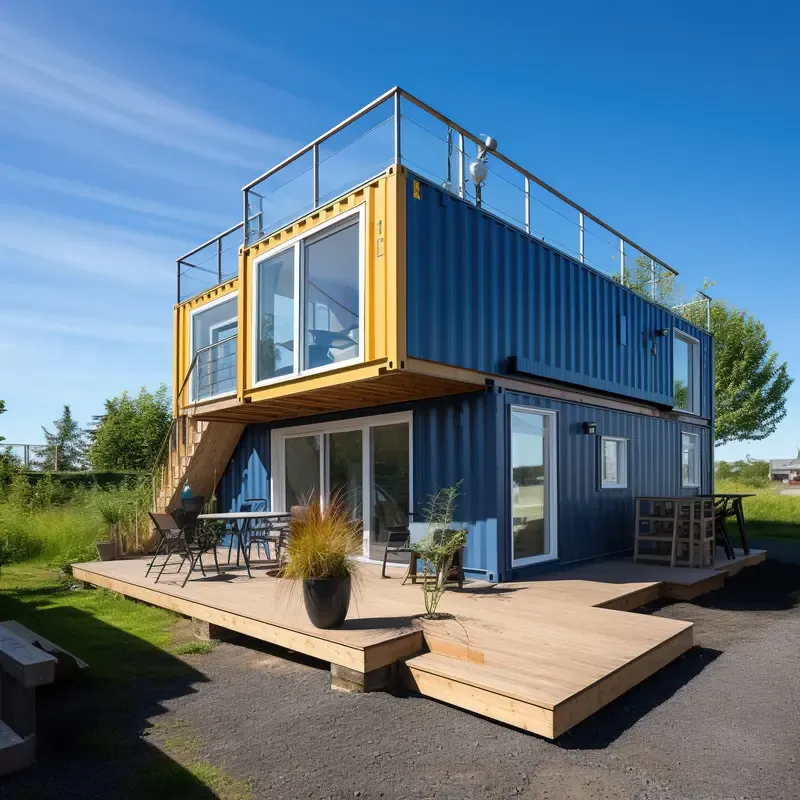
Prefabricated container houses may also be more predictable in pricing than custom-built ones. This is because the major work is done in factories; inspections can be done earlier; and assembly work is also faster.
That is why container homes have become synonymous with other pre-fabricated housing solutions. Finishing in factories ensures minimal delays caused by climatic conditions, coordination, and labor uncertainty, which can affect budgets without being noticed.
However, this is not necessarily turn-key construction, and such factors like foundation work, connection of utilities, transportation, issuing of permits, among others, constitute a major expenditure.
The cost impact of design choices has turned out to be more significant than many realize.
The simplest rectangular configurations that involve little cutting of containers make structural constructions simpler. Arrangements involving stacked containers, extensive use of glass, and cantilevers raise structural complexities.
One study in the MDPI: Buildings Journal on shipping container house designs using shipping containers has demonstrated the role of reinforcement, performance, and sustainability in shaping the complexity and cost of the process.
Each design has a financial shadow. The trick is in determining which ones will help in adding value for where it will be used.
Whether an apartment built from a shipping container will prove to be more economical than other forms of housing has a lot to do with where one lives
In high-cost urban markets, shipping containers may have an edge as the value of time and labor becomes important. For regions that cost less, traditional wood framing may be as viable of an option because of an established infrastructure.
It seems from the HUD results that affordability increases are possible most reliably when factory-based construction techniques are coupled in an organized fashion by regulation at the local level. Otherwise, the use of containers could be relegated to specialty endeavors.
A more pertinent question would not be whether a shipping container house is inexpensive but rather whether it is cost-effective in terms of your concerns.
In matters of speed, modularity, and malleability, the cost of the containers can be easily justified. However, in the event that the ultimate concern is the cheapest price available per square foot, other manufactured or conventional methods may be just as adequate. In container homes, planning pays off.
A container home can be cost-effective, but only in proper alignment with terms of design, size, and regulations. In a container home, the cost container itself entails a small price tag. The major price tag exists in the insulation, structure, land work, or compliance.
If you are contemplating container housing in earnest, consider the cost not only of the unit but the overall project. Compare that to other pre-made structures available and discuss the project with local building authorities early on and be up front regarding its complexity.
To explore shipping container home designs and available solutions, visit our product.

How to Optimize Thermal Management in Solar Container
The Future of High-Density Storage: 5MWh+ in a Single 20ft Container

Second-Life EV Batteries in Solar Containers: Technical Challenges and Solutions

Corrosion Resistance 101: Why C5-M Coating is Essential for Offshore Solar Platforms

The Role of Smart Monitoring Systems in Extending Solar Container Lifespan