
2025-12-16
Container energy storage has become the cornerstone for modern battery energy storage deployment. A container energy storage system integrates batteries, power electronics, control, and safety equipment into a standard shipping container to realize rapid installation and easily scalable capacity. Container energy storage systems are thus in the real functionality to cope with the variability and increasing demand for flexibility of the entire electricity system.
The U.S. Department of Energy recognizes that battery energy storage systems are a priority technology in ensuring reliability at the grid, integrating renewable energy, and ensuring operational resilience, and that standardized and modular designs accelerate deployment and reduce project risk. The position is outlined in the DOE's report on battery energy storage systems that frames BESS as foundational infrastructure for future power systems. U.S. Department of Energy - Battery Energy Storage Systems Report
The International Energy Agency reinforces this at the global level by pointing out that, as renewable penetration goes up, enabling power system flexibility will depend on large-scale battery storage. According to the World Energy Outlook 2025, battery storage is a prime enabler of supply-demand balance in increasingly electrified economies. International Energy Agency-World Energy Outlook 2025
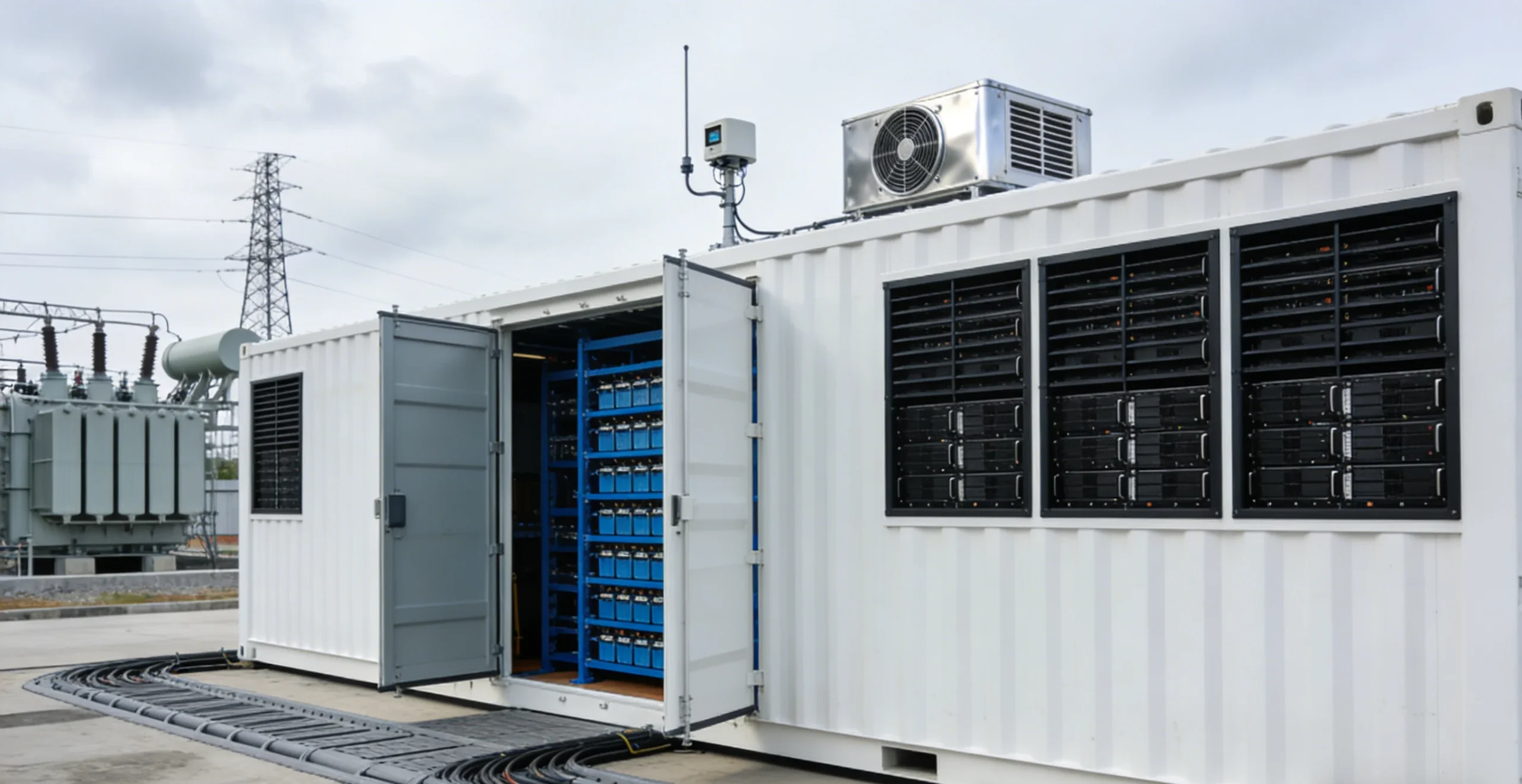
A container energy storage system is a battery energy storage solution in a standardized container, a 20 foot or 40 foot unit. Each container functions as a self-contained energy asset that can be transported, installed, and connected with minimal on-site construction.
Within an energy storage container, several subsystems come together in one engineered package. These include, but are not limited to, battery modules, battery management systems, power conversion equipment, thermal management components, and safety systems. The integrated design of these components differs significantly from the traditional building-based installation methods, which are many times custom in nature and take longer to construct.
With standardization, the container energy storage systems can be easily replicated in multiple projects. Developers have reduced engineering complexity to contend with, predictable performance, and a consistent safety design.
Their wide acceptance of container energy storage systems has been due to the practical advantages that come with modern grid and project requirements.
Container energy storage systems are assembled and tested at factories. Therefore, on-site installation mainly involves foundations, electrical connections, and commissioning. This significantly reduces deployment timelines as compared to custom-built battery facilities.
Each container is a block of defined energy capacity and power output. Additional containers can be added to scale projects without having to redesign the overall system architecture. This modularity supports phased investment and future expansion.
The safety of batteries is the key consideration in the energy storage project. The container energy storage systems apply consistent approaches to ventilation, fire detection, and thermal control. According to the U.S. Department of Energy, these standardized safety practices reduce operational risk for the entire life cycle of the battery energy storage systems.
Understanding the major components inside an energy storage container helps explain how performance and reliability are achieved.
Battery cells are integrated into modules and racks that define the total energy capacity of the container. Battery management systems monitor voltage, temperature, and state of charge to assure balanced operation and early detection of abnormal conditions.
Energy flows between the batteries and either the grid or a local load through the power conversion system. This system converts the direct current from the batteries to alternating current, while the charging and discharging are controlled according to the control signals and system requirements.
Temperature is the most important factor in the efficiency and life span of a battery. Container energy storage systems utilize cooling and ventilation systems to maintain operating conditions within a safe and optimal range, even in difficult climates.
Integrated monitoring platforms provide real-time visibility into the system status and performance. The systems support remote operation, diagnostics, and maintenance planning for both single containers and large multi-container installations.
Container energy storage systems support all conceivable use cases across the energy sector.
In utility scale, container energy storage systems are paired with solar and wind projects at most cases. They store excess generation and release energy when output declines, improving grid stability and reducing renewable curtailment. The International Energy Agency also earmarks large-scale battery storage as one of the critical flexibility resources for power systems with a high share of VRE.
Energy storage containers help lower the peak demand for electricity in commercial and industrial settings. Organizations can reduce peak demand charges and stabilize operating costs by releasing stored energy during high demand periods.
Containerized energy storage systems can provide the necessary backup power in a fast-responding action for critical infrastructures like data centers, healthcare facilities, and remote operations. Battery systems would respond instantly to outages and provide resilience strategies with lower operational emissions than traditional generators.
Even being standardized, a container energy storage system requires close attention to planning for its performance and compliance in the long term.
Site design shall include adequate spacing, access routes, and ventilation. Containers shall be located to permit safe operation, accessibility for maintenance, and to meet the requirements of electrical and fire safety.
The energy capacity and discharge duration shall be designed to meet the intended application. Applications for grid services might need longer-duration storage, whereas peak management generally requires higher power output over extended runtime.
The capacity of batteries degrades with time. This should, therefore, be planned for through performance modeling, maintenance strategies, and end-of-life considerations. According to the U.S. Department of Energy, lifecycle planning is critical to responsible battery energy storage deployment.
| Aspect | Container Energy Storage | Building Based BESS | Custom Enclosures |
| Deployment speed | Fast | Moderate | Slow |
| Scalability | High | Medium | Low |
| Standardization | High | Medium | Low |
| Site flexibility | High | Low | Medium |
| Typical use cases | Utility scale and commercial | Permanent facilities | Specialized projects |
This comparison also underlines the reasons behind why container energy storage systems are often chosen in projects that require speed, scalability, and repeatable design.
Global demand for energy storage is bound to keep increasing due to the decarbonization of power systems and electrification expansion. The World Energy Outlook 2025 is foretelling further growth in battery deployment to accommodate renewable integration, grid stability, and energy security. Containerized solutions would probably remain dominant because of their adaptability and compatibility with evolving battery technologies.
Container energy storage systems represent a practical and scalable method of deploying battery energy storage in modern power systems. Finding a balance between standardized design, integrated safety features, and modular expansion, container energy storage underpins renewable integration, grid flexibility, and energy resilience. If you are interested in container energy storage, you can check our project planning resources to evaluate how a containerized BESS can support your energy strategy.
How to Optimize Thermal Management in Solar Container
The Future of High-Density Storage: 5MWh+ in a Single 20ft Container
Second-Life EV Batteries in Solar Containers: Technical Challenges and Solutions
Corrosion Resistance 101: Why C5-M Coating is Essential for Offshore Solar Platforms
The Role of Smart Monitoring Systems in Extending Solar Container Lifespan